
Why Botox Results Vary: Longevity, Units, and Choosing the Right Injector
TL;DR
Botox results vary because of four main factors: how many units were used, how skillfully they were placed, the product's quality and dilution, and your individual metabolism and muscle activity. Most patients should expect 3 to 4 months of results, with some reaching 4 to 5 months once their treatment pattern stabilizes. Results lasting only 2 months almost always point to underdosing, diluted product, or imprecise placement, not something wrong with your body.
If you have ever compared notes with a friend about Botox and realized her results lasted two months longer than yours, you already know this treatment is not one-size-fits-all. Patients across Boca Raton ask us the same question in different words: why did my Botox wear off so fast, and why does someone else's last four months on the same number of units?
The honest answer is that Botox longevity depends on more than the injection itself. It depends on who is holding the needle, what is actually in that syringe, and how your own body responds to it. This guide walks through the real reasons Botox results vary, what counts as normal, and what should send you looking for a new injector instead of blaming your metabolism.
How Long Should Botox Actually Last?
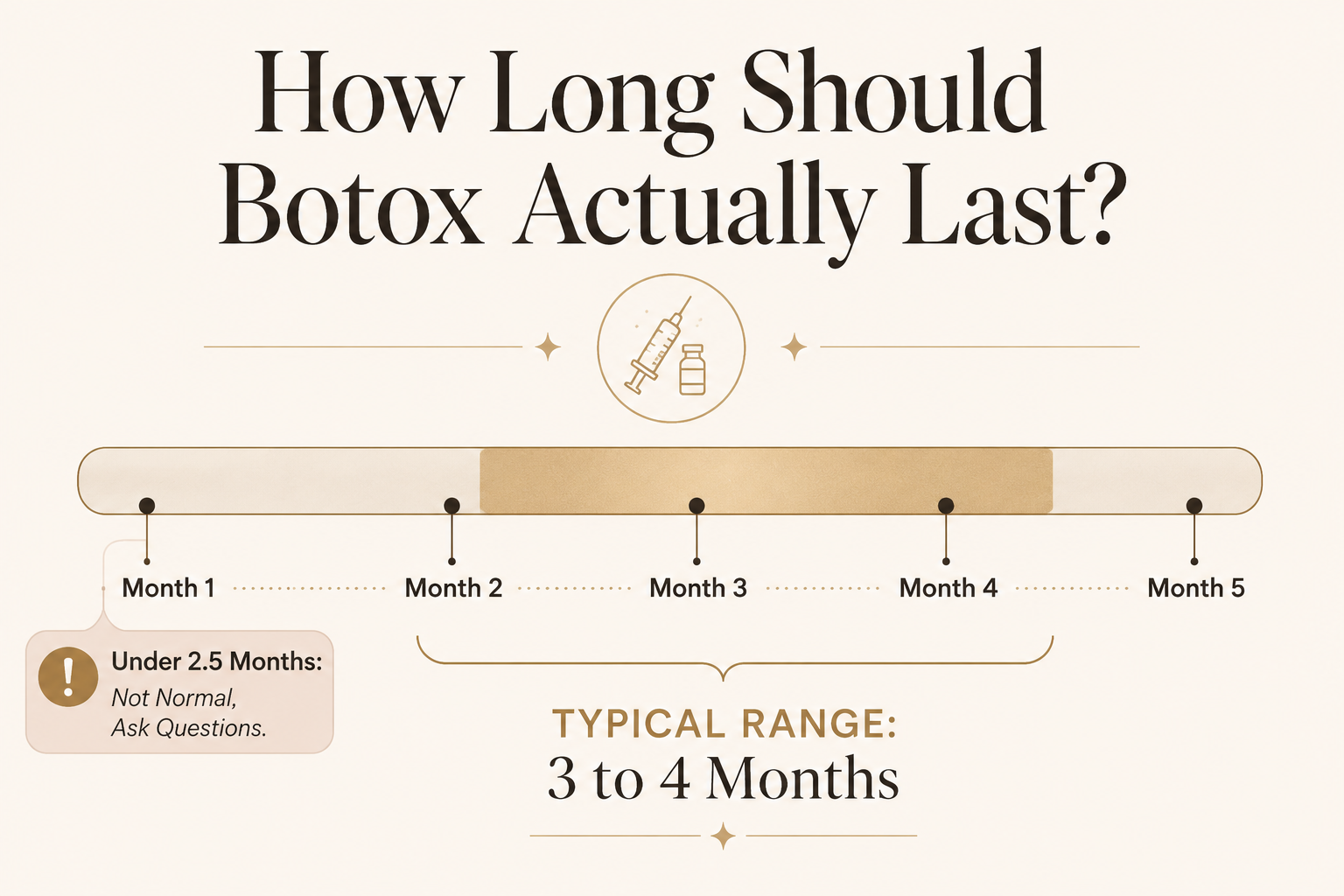
Botox should typically last 3 to 4 months for most patients, with some achieving 4 to 5 months after consistent treatment over 12 or more months. Results lasting fewer than 2.5 months almost always indicate something went wrong in the dosing, product, or technique, not your metabolism.
The Normal Botox Duration Range
Think of 3 to 4 months as the baseline range you should expect from a well-dosed, well-placed treatment. Patients who stay consistent with their appointments often stretch that window further over time, because repeated treatment gradually weakens the targeted muscle. This is one reason longtime Botox patients tend to report longer-lasting results than someone trying it for the first time.
When Shorter Duration Is and Isn't Normal
A slightly shorter window in your first one or two treatments is normal and expected. A pattern of consistently short results, especially under 8 weeks, is not. That pattern usually traces back to the injector's choices rather than anything happening inside your body.
Why Did My Botox Only Last Two Months?
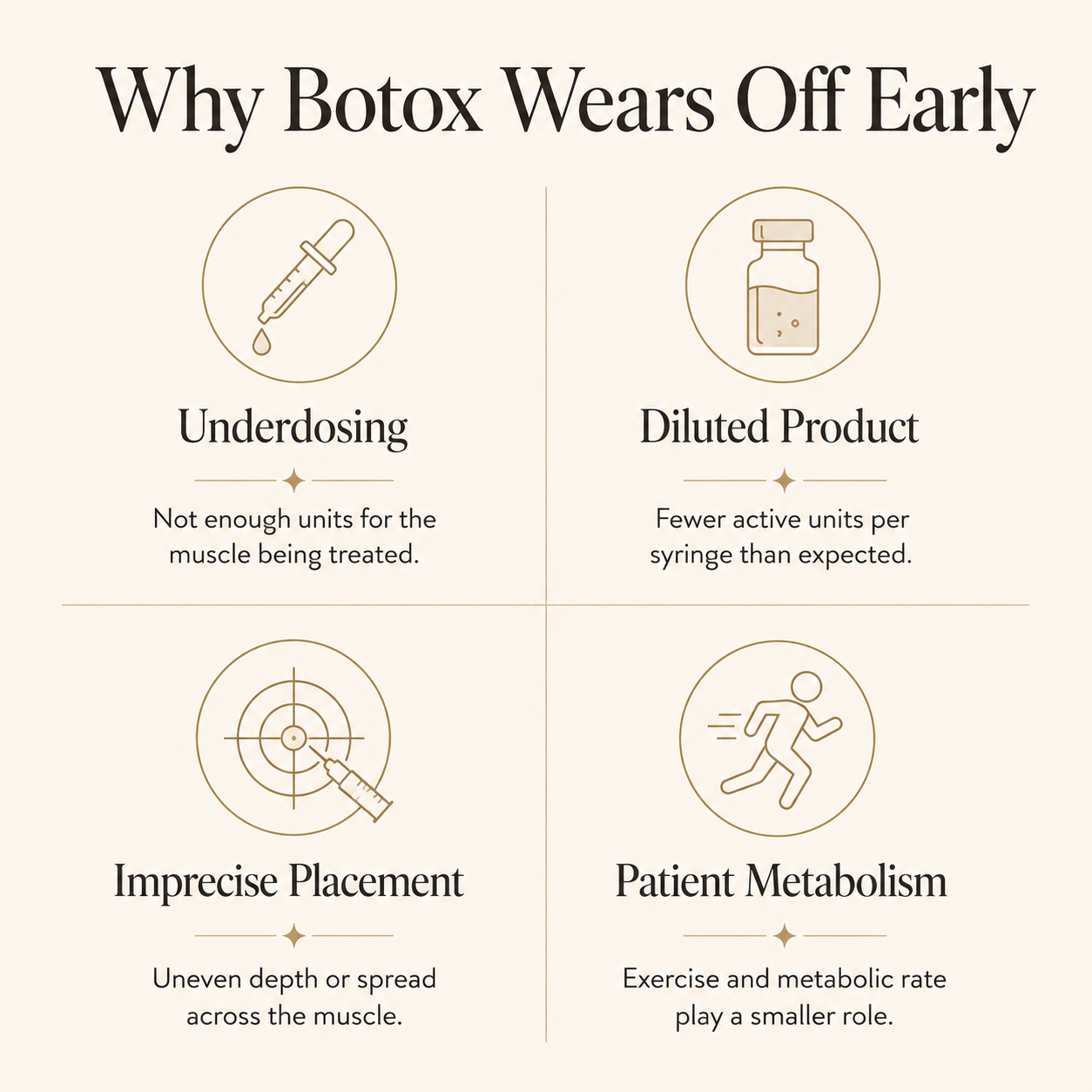
If your Botox only lasted two months, the most likely reasons are underdosing, diluted product, imprecise placement, or, less commonly, exercise-induced rapid metabolism. The first three are within the injector's control. Only the last one is truly on you.
The Underdosing Problem
Botox is dosed in units, and the areas of the face require specific ranges to work effectively and last a reasonable amount of time. An injector trying to stretch a vial across more patients, or simply undertrained in proper dosing, may use fewer units than your muscle strength requires. The result looks fine at first, then fades early.
The Diluted Product Problem
Some practices dilute Botox more than standard protocols call for for cost reasons. What Botox should actually cost often comes back to this exact issue, since heavily diluted product is how some providers offer lower prices while quietly giving patients less actual toxin per unit billed.
The Placement Accuracy Problem
Precision matters as much as quantity. An injector who places Botox slightly off target, or who spreads it unevenly across the muscle, can produce a treatment that looks acceptable in week one but breaks down faster than it should.
The Metabolism Factor
Some patients genuinely process Botox faster due to a high metabolic rate or frequent intense exercise. This is real, but it is far less common than the three injector-controlled factors above, and it is rarely the sole explanation for a two-month result.
What Patient Factors Actually Affect Botox Longevity?
The patient factors that genuinely affect Botox longevity are exercise frequency, metabolic rate, muscle strength and activity, and how recently you started treatment. New patients sometimes metabolize Botox faster than longtime patients simply because the muscle has not yet been weakened by repeated treatment.
Exercise and Metabolism
High-intensity training, particularly cardio started within 24 hours of treatment, can modestly speed up how quickly your body metabolizes Botox. The effect is smaller than most patients assume, but it is worth knowing if you train hard and notice shorter results.
Muscle Strength and Activity
Naturally strong facial muscles, common in patients who are very expressive or who grind their teeth, can push through Botox sooner than average. This is one reason the same unit count can produce different timelines for two different patients.
First-Timer vs. Long-Term Patient Differences
If this is your first time trying Botox, expect results on the shorter end of normal. Once you settle into a consistent schedule, most patients find their results stretch out and become more predictable session after session.
How Does Product Dilution Shorten Botox Results?
Diluted Botox contains fewer actual units of botulinum toxin per unit billed. If a practice over-dilutes to lower cost per treatment, you receive less product than the unit count suggests, and results fade sooner. This is one of the most common reasons discount Botox feels noticeably weaker.
How Dilution Works
Botox arrives as a powder that must be reconstituted with saline before injection. Standard dilution ratios are well established. Practices that stretch a vial further to serve more patients per unit purchased are not necessarily doing anything illegal, but the patient experience suffers, and it rarely gets disclosed upfront.
How to Ask About Dilution Practices
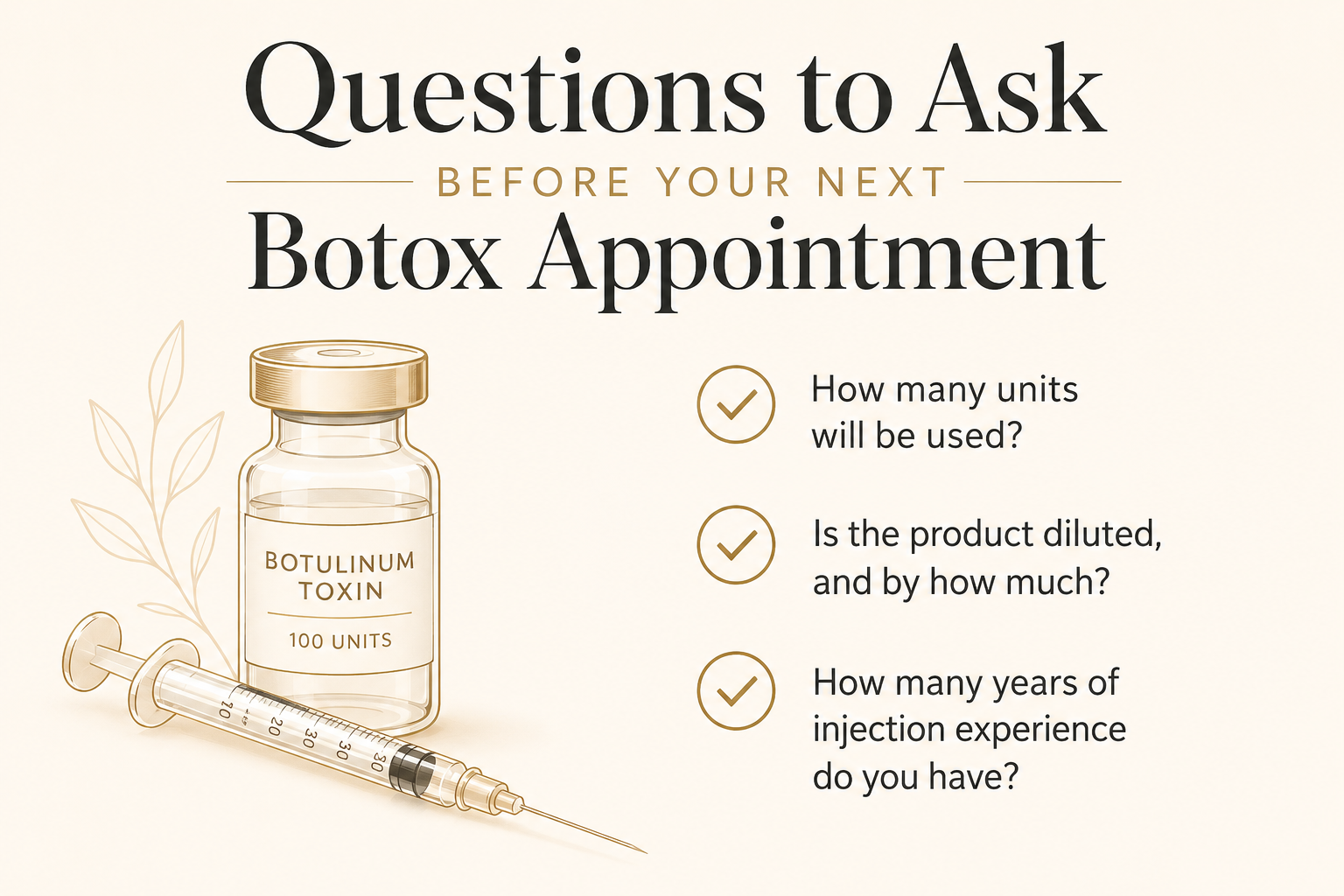
You are entitled to ask your injector directly how their product is diluted and how many units they plan to use for your treatment areas. A board-certified injector confident in their technique will answer plainly. Vague or dismissive answers are worth paying attention to.
How Does Injector Technique Affect How Long Botox Lasts?
Injector technique affects longevity through depth of placement, distribution across the muscle, and avoidance of muscle splitting that can allow activity to return faster. A precisely placed dose lasts longer than a sloppily placed one, even at identical unit counts.
Why Placement Matters as Much as Dose
Two injectors can use the exact same number of units and get very different results. The one who understands facial anatomy and places the product at the correct depth and spread will consistently outperform the one who does not, regardless of how many units either used.
What Anatomical Precision Looks Like
Precision means treating the muscle as a whole rather than a single point, adjusting for the patient's individual anatomy, and avoiding areas where imprecise injection can cause uneven results or a heavier brow. This level of care is exactly what separates an experienced injector from someone newer to the field.
How to Maximize Your Botox Longevity
To maximize Botox longevity, work with a board-certified injector who uses non-diluted product, follows a consistent treatment schedule over 12 or more months, and customizes dosing to your specific anatomy. On your end, avoid extreme cardio in the 24 hours after treatment and stay on a regular maintenance schedule.
Pre-Treatment Optimization
Come in with a clear picture of your goals and any history of past treatments that felt short-lived. That history helps your injector adjust dosing and placement rather than repeating whatever didn't work before.
Post-Treatment Maximization
Skip strenuous exercise, facials, and lying flat for a few hours after treatment. These small habits protect the product's placement while it settles into the muscle.
The Maintenance Schedule That Builds Longevity Over Time
Sticking to a consistent 3 to 4 month schedule allows the treated muscle to weaken gradually over time. Patients who follow this pattern for a year or more frequently report longer stretches between appointments than they experienced when they started.
Frequently Asked Questions About Why Botox Results Vary
Why did my Botox only last 2 months?
Botox lasting only two months almost always indicates underdosing, diluted product, or imprecise placement, all of which are injector-controlled factors. Less commonly, it reflects rapid metabolism, intense exercise, or being a new patient whose muscle hasn't yet weakened from consistent treatment. If it happens once, it's worth changing injectors before changing your routine.
Can I make my Botox last longer?
You can extend your Botox longevity by avoiding extreme cardio for 24 hours after treatment, staying consistent with your treatment schedule, and working with an experienced injector who uses precise placement and non-diluted product. Patient-side habits help, but injector quality matters more.
How long should Botox last on a first-time patient?
First-time Botox patients typically see 2.5 to 3.5 months of results, slightly shorter than long-term patients, because the treated muscle is at full strength. With consistent treatment over 12 or more months, the muscle weakens and Botox typically lasts 3.5 to 4.5 months.
Does exercise really make Botox wear off faster?
High-intensity exercise can modestly accelerate Botox metabolism, particularly when started within 24 hours of treatment. The effect is real but smaller than commonly believed. Underdosing and dilution are far more common explanations for short-duration results.
Is it normal for Botox to wear off in 8 weeks?
No, Botox wearing off in 8 weeks falls below the typical range and usually points to an issue with dosing, product, or technique. Most patients should expect 3 to 4 months of results. If yours consistently wears off in 8 weeks, it's worth seeking a second opinion with a board-certified injector.
Desirae Lymber's Perspective
"When a patient tells me their last Botox only lasted two months, I have a list of questions I ask in this order: how many units were used, when was the appointment, how was it dosed across the areas, and was the product clearly labeled. Most of the time, the answers tell the story, and it almost always points back to the injector, not the patient. In my experience, patients who switch to consistent treatment with a precise injector usually see their longevity normalize within two or three sessions."
— Desirae Lymber, Board-Certified Nurse Practitioner
Ready for Botox That Actually Lasts?
If your last Botox faded faster than it should have, that is worth a second look rather than a shrug. At Injection Perfection, every treatment plan starts with a consultation where Desirae reviews your history, discusses dosing openly, and builds a plan around your anatomy rather than a one-size-fits-all unit count.
We serve patients throughout Boca Raton, Delray Beach, Highland Beach, Deerfield Beach, and Boynton Beach, using non-diluted product and transparent dosing from a board-certified injector with over 10 years of experience. If your results have been inconsistent elsewhere, our real reasons Botox doesn't last breaks down exactly what to look for before your next appointment.
Book Your Botox Consultation and let's build a treatment plan around what your face actually needs, not just what a syringe happens to have left in it. Explore
Botox in Boca Raton to see how we approach dosing and technique differently.
Like what you read? Share it!